
German Grammar Shortcuts That Actually Stick
You don’t need to memorize everything. We show you the patterns that matter most and how native speakers actually think about grammar.
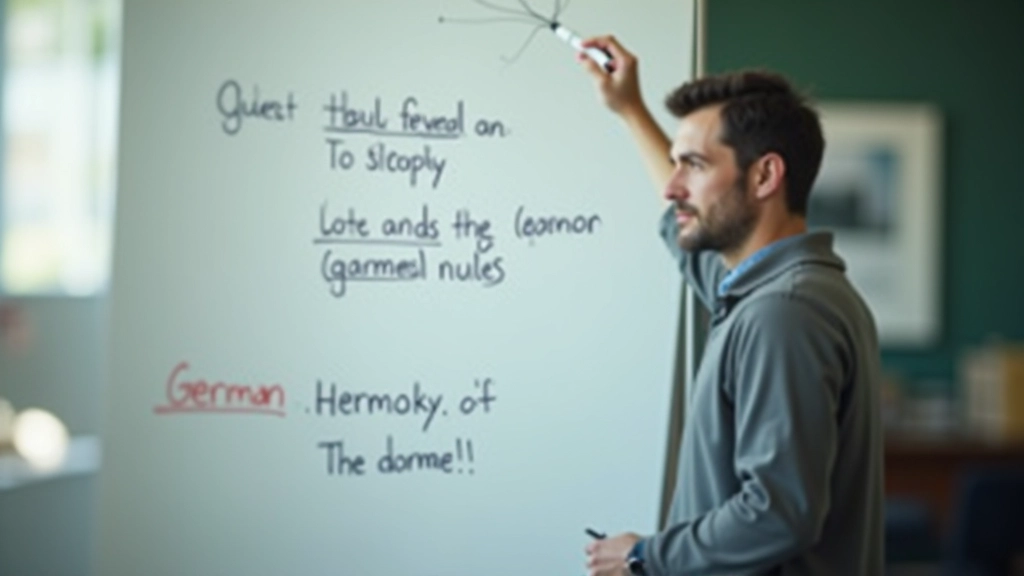
Why Grammar Feels Impossible (It Isn’t)
Most language classes teach grammar like it’s a list of random rules. You memorize case endings, verb conjugations, prepositions — and then you forget them. That’s because your brain isn’t wired to memorize lists. It’s wired to recognize patterns.
Native speakers don’t think about grammar rules when they speak. They think in patterns. “That sounds right” or “That doesn’t sound right.” We’re going to show you how to develop that same instinct — faster than you’d think possible.

The 5 Patterns That Matter Most
These aren’t all the grammar rules in German. These are the ones that show up constantly in real conversation.
The Accusative Object Pattern
Here’s the pattern: when something receives the action, it changes. “Ich sehe den Mann” (I see the man). Not “der Mann” — “den Mann.” You’ll use this hundreds of times. In conversation, you’ll start hearing it without thinking about it. It takes maybe 3 weeks of actual exposure.
Modal Verbs Come at the End
English: “I can go home.” German: “Ich kann nach Hause gehen” (literally “I can go home” but the main verb goes at the end). Once you see this pattern three times, it sticks. Your brain automatically expects the main verb to come last in sentences with modals.
Separable Verbs Split in the Middle
Verbs like “anrufen” (to call) split: “Ich rufe dich an” (I call you). The “an” goes at the end. Sounds weird until you hear it 20 times. Then it becomes normal. Native speakers don’t think about it — the pattern is automatic.
Dative for Indirect Objects
When someone receives something indirectly, use dative. “Ich gebe dem Mann das Buch” (I give the man the book). You don’t memorize this — you absorb it through listening and repeating. About 4-5 weeks of regular conversation and it clicks.
Past Tense: Perfekt is Everyday
Germans speak about the past using perfekt, not preterite. “Ich bin nach Berlin gefahren” (I went to Berlin). It looks complicated but it’s really just “I am gone to Berlin.” Once you get the pattern of “have/be + past participle,” it becomes your default.
How Patterns Actually Stick
You don’t learn grammar through repetition exercises. You learn it through exposure and production. Hearing a pattern 50 times in context is better than writing it 500 times in isolation.
Here’s what actually works: Listen to something (a conversation, a video, a song). Notice the pattern. Try to use it yourself in the next conversation. Get feedback. Do it again with a different example. That cycle repeats, and after 6-8 weeks of consistent exposure, the pattern is locked in.
This is why immersion works so well. You’re not “studying grammar” — you’re just trying to communicate. The patterns absorb naturally because your brain is wired to recognize them through real usage.

The 3-Week Shortcut Strategy
If you’re starting from scratch, here’s the most efficient path to pattern recognition.
Listen First, Analyze Later
Spend this week just listening. Podcasts, conversations, videos. Don’t try to understand everything. You’re training your ear to recognize the sound patterns. Your brain is starting to build templates of what sounds “German.” This foundation makes everything that comes next easier.
Notice and Repeat
Now you start paying attention to specific patterns. You hear a verb at the end of a sentence. You notice it happens consistently. You repeat that sentence structure 3-4 times. You’re not memorizing — you’re getting the pattern into your muscle memory through repetition and speaking.
Start Using It
In conversation, you start attempting these patterns. You’ll get it wrong sometimes. That’s the whole point. Your brain corrects itself through feedback. After 3 weeks of this cycle, you’ve internalized the most essential patterns. You’re not thinking about grammar anymore — you’re just speaking.
The Mistake Everyone Makes
Students try to learn grammar in isolation. They drill case endings for hours. They fill out worksheet after worksheet. Then they get into a real conversation and freeze. All that drilling didn’t build pattern recognition — it built memorization that vanishes under pressure.
The shortcut? Don’t separate grammar from conversation. They’re not two different things. Grammar is just the pattern that makes communication possible. When you practice grammar in context — in real sentences, with real meaning — your brain actually learns it.
That’s why conversation bootcamps work. You’re not sitting in a classroom diagramming sentences. You’re trying to communicate something you actually want to say. The grammar patterns emerge naturally because they’re serving a purpose.

What Native Speakers Actually Do
Here’s the honest truth about how grammar works for people who speak German natively.
“I don’t think about grammar when I speak. I just speak. If something sounds wrong, I correct it. But I’m not consciously applying rules — the patterns are automatic.”
— Tobias, native German speaker
That’s the target. Not perfect grammar. Not flawless case endings. Automatic pattern recognition that lets you communicate naturally. Native speakers learned this through thousands of hours of exposure and production — starting as children. You can compress that timeline significantly by focusing on patterns instead of rules.
The patterns you learn in a bootcamp environment aren’t “optional” — they’re the foundation. But they’re also not complicated. They’re just the most frequent ways Germans structure sentences. Once you recognize them, everything else becomes much easier to learn.



About This Article
This article is educational and informational in nature. The learning approaches and timelines described are based on common language acquisition patterns, but individual results vary significantly. Everyone’s learning pace is different. What takes one person 3 weeks might take another 6 weeks — that’s completely normal. Grammar learning is a process, not a destination. The patterns we’ve highlighted are the most frequent ones in conversational German, but mastery comes through consistent practice, feedback, and real conversation over time. Consider working with qualified language instructors for personalized guidance on your specific learning goals.